
Chasing down a dream
June 09, 2026
This is the second installment in a series of four veterinary students sharing the grit, grace, and glory involved in pursuing their dreams. Together, their stories reveal not just what it takes to become a veterinarian, but how that transformation unfolds—year by year.
Saige Annison, Year 2
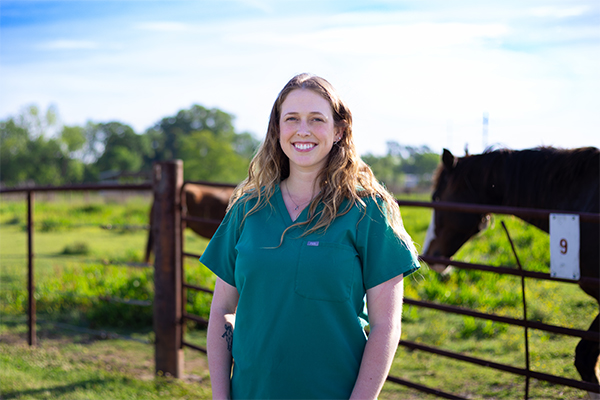
Saige Annison
Saige had an early relationship with horses that set her on a long, demanding path to veterinary medicine, one defined by persistence and steady progress. Now in her second year, she has completed Phase 1 of her DVM coursework and is preparing to begin a three-year PhD program in January 2027 as part of a dual-degree track. She plans to finish the PhD in December 2029 before returning in January 2030 to complete her clinical rotations.
For Saige, the sustained dedication required of pairing a DVM with a PhD is worth the effort. The dual degree will help her to connect scientific discovery with real-world clinical application. Mentored by her MS adviser, Dr. Britta Leise, she has found a model for the kind of career she is working to build—one that bridges biomedical science and patient care, with an interest in sports medicine and internal medicine. She’s particularly drawn to studying macrophages—key immune cells that help regulate inflammation and tissue repair.
Her research pursuits began early. In 2024, she earned her master of science degree from LSU Vet Med, studying how cellular communication systems may contribute to laminitis, a painful and often chronic hoof condition in horses. Her interest in the disease emerged from the 2016 flood in Denham Springs, where her horse Rex developed severe laminitis after standing in floodwaters. His long recovery and the care provided by LSU veterinarians left a lasting impression.
Raised in the world of competitive three-day eventing, Saige grew up riding, training, and caring for horses. “Horses are the ultimate teacher,” Saige said. “You may be hurting after competition, but you still have to care for them. They don’t know the score—you just tell them they’re the best.”
The discipline of the sport and organizations like the United States Pony Club instilled in her a strong sense of responsibility and horsemanship. That foundation extended beyond riding. She even interned with a farrier to better understand hoof care. “No hoof, no horse,” she said, sharing that a horse's health and survival depend on the strength and health of its feet.
Her academic path to veterinary school differs from many of her peers. Since arriving at LSU in 2018, she has earned a BS in animal science, shifted to complete her MS, and entered the DVM program—all while building a clear vision for her future.
The transition into veterinary school was intense. “The first year was overwhelming,” she said. But by her second year, she found her footing. “I adapted and kept going. One day, things just clicked.”
Through it all, one constant has made vet school manageable: her classmates. “We lean on each other a lot,” she said. “We’re going through this together.”