Current Students
Our current MA and PhD students are working on a range of exciting projects that span the globe!
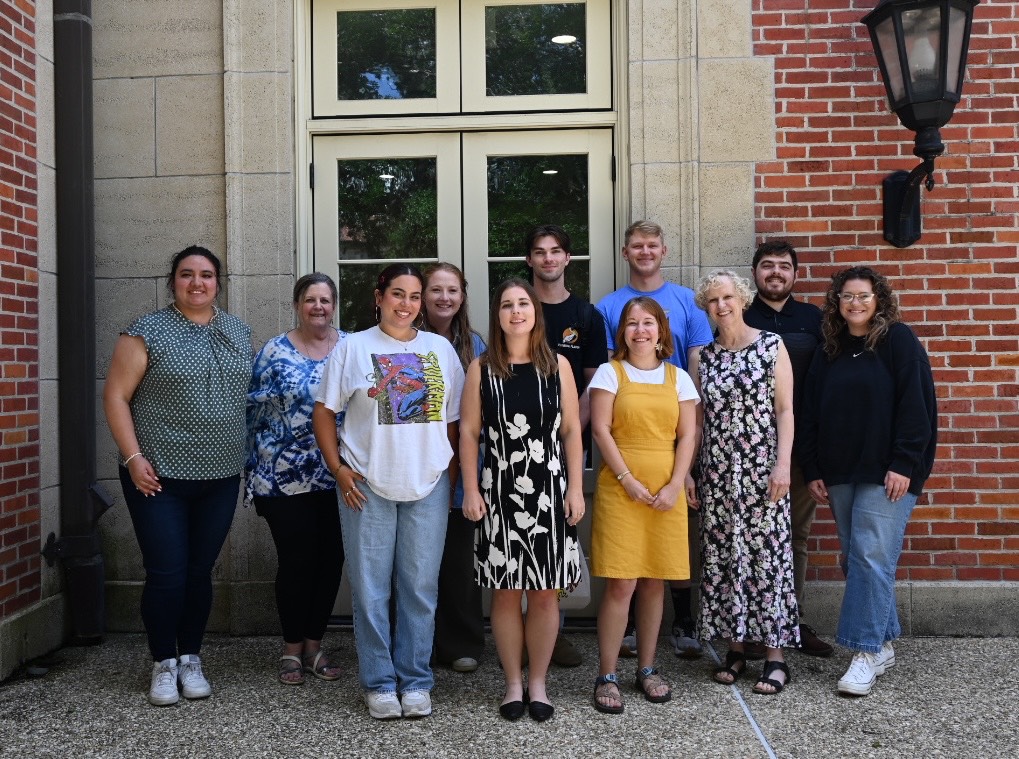
The students in Dr. Veldman's HIST 7957/7909 Research Seminar (Spring 2025) made progress on their thesis writing over the course of the academic year.
Rickey Baisley
PhD student
US history
Advisor: Dr. Stephen Prince
Rickey researches changing religious beliefs about death in the nineteenth-century South. His dissertation examines post-Civil War syncretism of Spiritualist practices and Anglo-Protestant beliefs as well as changing mourning practices during the chaos of Reconstruction.
Michael Baranick
PhD student
British history
Advisor: Dr. Victor Stater
Michael's research focuses on Jesuit activity in Elizabethan England. He is specifically interested in the 1580 plot by the Jesuits to remove Elizabeth I from the throne. Additionally, he focuses on the role that the Jesuit activity and influence played on future plots to assassinate Queen Elizabeth and replace her with a Catholic monarch.
Mikal Barnes
PhD Student
US History
Advisor: Dr. Kodi Roberts
Mik's research traces the tradition of African American grassroots organizing against White supremacist control in Shreveport, Louisiana, from Reconstruction through the height of the Civil Rights Movement. Additionally, his research expands to include the regressive reactions to said activism in Shreveport and greater North Louisiana, establishing the context for whom activists were organizing against. It broadens to include connections with developments in national movements, just as the region's proponents of White supremacy and racial equality expanded and quietly spread their influence and ideologies across the United States.
Marie Blanquinque
PhD student
US History
Advisor: Dr. John Bardes
Marie’s areas of interest encompass Creole dances, performative politics, and resistance. Her current research explores Creole performances as arenas of resistance, negotiation, and revolutionary expression in the Atlantic World in the eighteenth and nineteenth centuries. She investigates Creole dances as political acts of defiance, examining how movement and embodied gestures served as vehicles for the circulation of revolutionary ideals in Louisiana and in the Caribbean.
Madelynn Bonvillain
MA Student
US History
Advisor: Dr. Alecia P. Long
Madelynn studies presidential history, often through the office of the first lady. Her current project explores the dynastic nature of the White House and the first lady’s role as a key actor in American socialite culture using Dolley Madison and Jaqueline Kennedy as case studies. These women were in office during key moments in American history which shaped their influence as leaders of American high society.
Charles Boustany
PhD Student
European History
Advisor: Dr. Suzanne Marchand
Charles is researching the international intellectual history of peace in nineteenth-century Europe and the development of the ideas, institutions, and architecture of the new European security culture after 1815.
Mateline Bratton
PhD student
US history
Advisor: Dr. Jessica Blake
Mateline's research focuses on women's healthcare in the colonial South, with particular attention to the development and practice of early gynecology and obstetrics. She is specifically interested in the roles of midwives and professional medical practitioners in women's reproductive healthcare and how access to and reliance on different forms of care varied across social classes. Additionally, her research examines how women themselves participated in, shaped, and transmitted medical knowledge surrounding pregnancy, childbirth, and reproductive health.
Noah Dubroff
PhD student
US history
Advisor: Dr. Julia Irwin
Noah is currently researching the American federal attitude and approach toward "Don" Pedro Albizu Campos, one of the most significant forces for the Puerto Rican nationalist and independence movement. This leader is one of the most influential figures in solidifying and defining the Puerto Rican identity, and his position as an antithesis to American control of Puerto Rico, an island lying at the entrance to the Caribbean. American fears of an uprising led the FBI to constantly surveil Albizu Campos, keeping a close record of his movements as well as actively trying to undermine the Puerto RIcan Nationalist Party.
Julian Flesch
PhD Student
US History
Advisor: Dr. K. Stephen Prince
Julian’s research analyzes the role of intellectuals in shaping the Lost Cause myth in the American South and nationwide from the end of the Civil War to the Civil Rights movement. Of particular importance are historians and novelists. His research traces how white Southern and Northern thinkers developed and popularized the myth, interactions with the public, and the public reaction to these figures. Julian’s project also examines opposition to the Lost Cause from white and Black intellectuals, Northern and Southern, in the decades after the Civil War, especially Frederick Douglass, Albion Tourgée, and W.E.B. Du Bois. His research seeks to answer broader questions about the role of the intellectual in American life, the power of the Lost Cause in American memory, the importance of opposition to it, and why the Lost Cause still lingers in popular consciousness.
Logan Fontenot
PhD student
US history
Advisor: Dr. Zevi Gutfreund
Logan's current research explores the desegregation and integration of Louisiana's state universities. He examines the legal strategies taken by legal representatives in desegregating institutions of higher learning. He also explores the racism and resistance faced by black students after desegregation and highlights the actions they took toward integrating.
Tristin Gaspard
PhD Student
US History
Advisor: Dr. John Bardes
Tristin researches the importance of the American acquisition period of Louisiana. His current work centers on William C.C. Claiborne and the 1811 Slave Revolt. Through examining the evidence surrounding the 1811 Slave Revolt, Tristin has found inconsistencies in the traditional telling of the revolt. His research analyzes enslaved and plantation records to trace involvement in the revolt and the geographic, social, and political factors that created an environment for revolt in Louisiana.
Emmitt Glynn, III
PhD student
US history
Advisor: Dr. John Bardes
Emmitt's research focuses on how enslaved African Americans used hunting practices to assert and negotiate ownership of private property with slaveholders during the nineteenth century. His geographic region of study is the Mississippi Valley. During slavery, African Americans hunted wild game to provide sustenance for themselves. Emmitt's goal is to understand how wild game procurement produced avenues of agency for enslaved people as evidence through the accumulation of property and secruing additional personal freedoms from slaveholders.
Rex Jones
PhD student
US History
Advisor: Dr. Alecia Long
Rex studies the origins and development of modern healthcare in Louisiana. Louisiana’s unique Charity Hospital System counted more than a dozen hospital facilities across the state and by the 1950s provided a degree of socialized medical care which exceeded almost any other state. By 1990, many in Louisiana described healthcare as a right. Changing economic organization, desegregation, and healthcare institutionalization altered the conceptions of charity and medical rights as Louisiana entered the twenty-first century and led to the end of the Charity System.
Spencer Jurgielewicz
MA/PhD student
US history
Advisor: Dr. Stephen Prince
Spencer examines corruption during the early Gilded Age with a focus on the scandals of the Grant Administration (1869–1877). Following the tradition of recent scholarship, his research aims to reevaluate the exact role corruption had in the administration’s decisions, as well as the legacy of the administration itself. A significant portion of his research focuses on examining the media’s coverage of scandals and their impact on public opinion. Spencer provides valuable insight into not only the history of political corruption of the Republican Party in the 19th century, but also the broader ramifications of political change over time in the United States.
Jesse LeBoeuf
MA Student
US History
Advisor: Dr. Catherine Jacquet
Jesse’s research interests lie at the nexus of gender and media history. Her current project examines The Mary Tyler Moore Show (1970-1977), with the aim of showcasing that the program was a perfect vehicle for introducing an unsuspecting audience to second-wave feminist concepts. This scholarship is a component of Jesse’s broader fascination with sitcoms’ unique ability to transmit changing social norms to audiences who otherwise would not be exposed, or willing to listen.
Lili LeGardeur
PhD Student
US History
Advisor: Dr. John Bardes
Lili LeGardeur studies migration subsequent to the Haitian Revolution with an emphasis on those migrants most poorly reflected in the documentary record, namely women and enslaved people. Her dissertation explores the negotiation of race, power and status within and between Saint Domingue emigrant households in New Orleans.
Robert Leverett
PhD student
British history
Advisor: Dr. Meredith Veldman
Robert studies 20th century South Asian migration into Britain. His dissertation is titled, "Punjabis in Britain: Postwar migration."
Akua Lewis
PhD student
US history
Advisor: Dr. Alecia Long
Akua's dissertation is an examination of the lives and experiences of Black women who interacted with the New Orleans Police Department, the Orleans Parish criminal courts, and the Orleans Parish civil courts. "How did class, race, and gender shape the lives of Black women living in Progressive Era New Orleans?” is the primary question Akua is seeking to answer through her research.
Stephen Marsalis
PhD student
US history
Advisor: Dr. Aaron Sheehan-Dean
Stephen's research focuses on the life and political philosophy of US Supreme Court Justice James Wilson.
Ricky Mather
PhD student
US History
Advisor: Dr. Julia Irwin
Ricky’s historical interest centers on the intersection of transnational medicine, public health, occupational health, military health, and imperial control in the late-nineteenth and early-twentieth centuries. His project compares public health initiatives in the United States, Britain and their overseas possessions, specifically Cuba, the Philippines, Panama, India, and Africa. He focuses on sanitary and health concerns within places of confinement and how coercion was used to regulate colonized populations and maintain wellness among colonial administrators and military personnel.
Charlie Miller
MA/PhD Student
US History
Advisor: K. Stephen Prince
Charles’ research examines how the second iteration of the Ku Klux Klan used the memory and image of the original Reconstruction Klan in their recruiting and other activities to fit their white supremacist agenda. His project examines literature of the early 20th century regarding the old Klan’s violence and other activities in the South in the wake of Reconstruction, utilizing documents produced by the Klan, as well as newspapers and other accounts of Americans who were either victims of or participants in the second Klan movement. Charlie hopes to reveal more about race relations at the time, as well as the long term effects of Reconstruction and white resistance to black empowerment.
Heather Redmon
PhD student
US history
Advisor: Dr. Julia Irwin
Heather studies the long durée of the flood of 1927.
Caleb Roark
PhD student
US history
Advisor: Dr. Aaron Sheehan-Dean
Caleb researches antebellum New Orleans’s mechanics population and how the leaders of the elite New Orleans Mechanics’ Society participated in region-wide debates concerning industrialization and slavery. Many of New Orleans’s commercial and political elites were members or friends of the Society, and the Society’s activities underscore the attempts by New Orleans businessmen to address the city’s latent manufacturing sector before the Civil War. Only through a diversified economy, they hoped, could the Crescent City retain its position as the South’s largest city and achieve parity with the North.
Danielle Russell
PhD Student
US History
Advisor: Dr. Aaron Sheehan-Dean
Danielle studies the Civil War and Reconstruction. Her current work centers on the connection between irregular warfare in the Civil War and state militias in Reconstruction. Southerners joined Union regiments for political and personal reasons and gained a reputation for lawlessness and brutality that extended to their actions as members of state militias years later, weakening public support for federal Reconstruction initiatives. Danielle’s work examines figures, such as George W. Kirk of the 3rd North Carolina Mounted Infantry, who symbolized resistance to the Confederacy and later the Ku Klux Klan. Her research analyzes the intersection of masculinity, mythmaking, and public perception to determine how soldiers’ reputations shaped the memory of the Civil War and Reconstruction across the nation.
Hayden Strittmatter
PhD Student
US History
Advisor: Dr. Aaron Sheehan-Dean
Hayden studies how the Crimean War and Florence Nightingale influenced Civil War medicine and nursing. Before the Confederates bombarded Fort Sumter, American and British newspapers portrayed Nightingale—the famed nurse of the Crimean War—as an angel of mercy and advertised and commented on her works, "Notes on Nursing" and "Notes on Hospitals." As the North and South readied for war, men and women turned to the Crimean War for guidance. Hayden’s work analyzes what Civil War men and women learned from Crimean War medical texts and Nightingale’s ideas on nursing, preventative medicine, and hospitals
Riley Vinson
MA student
European History
Advisor: Dr. Sherri Johnson
Riley’s research examines medieval English kingship in the high to late medieval periods and the interplay between religion, culture, and politics in individual decision making.
Dylan White
MA student
US history
Advisor: Dr. Catherine Jacquet
Dylan’s research examines leftist activism at Louisiana State University (LSU) during the 1960s and 1970s. His research examines organizations and protest efforts centering feminist, black radical, queer liberationist, prison abolitionist, anti-imperalist, and anti-capitalist rhetoric throughout this tumultuous period. Through his focus on student activism in the U.S. South, Dylan illustrates the often forgotten efforts of progressive Southerners and their ability to generate change. Dylan’s interests are informed by an intersectional feminist framework.